The House That Bends: Modular Luxury and the End of the Single-Purpose Room
There was a time when the surest signal of residential prestige was the room that served only one purpose. The billiard room. The morning room. The conservatory. These were spaces that announced, through their very specificity, that their owners possessed not merely wealth but an abundance of space — enough to dedicate square footage to a single function and leave it at that. The dedicated room, in other words, was a luxury of a particular kind: the luxury of excess.
The luxury market of the current moment is telling a different story. Across Manhattan and in premium urban markets from Chicago's Gold Coast to San Francisco's Pacific Heights, the most sought-after residential properties are no longer those with the most rooms or the most rigidly defined ones. They are the properties that can become whatever their owners need them to be — on a given morning, in a given season, in a given chapter of life. Flexibility, once a concession made by those who could not afford specialization, has become the defining aspiration of the sophisticated urban buyer.
The Permanent Imprint of Pandemic Living
To understand this shift, it is necessary to acknowledge the event that accelerated it beyond any marketing campaign or design trend cycle. The period beginning in early 2020 subjected the American home — at every price point — to demands it was never designed to meet. Guest bedrooms became recording studios. Dining tables became conference rooms. Living rooms were asked to function simultaneously as gymnasiums, classrooms, and corporate headquarters. For most households, this was an exercise in improvisation and frustration.
For affluent households in high-end urban properties, it was something more instructive. It revealed, often starkly, the limitations of fixed-function luxury. A home with a dedicated wine cellar and a formal receiving room but no adequate space for focused professional work was, in practical terms, deficient — regardless of its address or its price. The experience permanently recalibrated expectations, and those expectations have not reverted.
"The clients we work with now have a very clear memory of what didn't work," notes one Manhattan-based interior architect whose practice focuses exclusively on high-end residential projects. "They're not interested in spaces that look impressive in photographs but fail them on a Tuesday afternoon when they have four hours of video calls and a child doing homework in the next room. They want beauty and performance. Both. Simultaneously."
What Adaptive Luxury Actually Looks Like
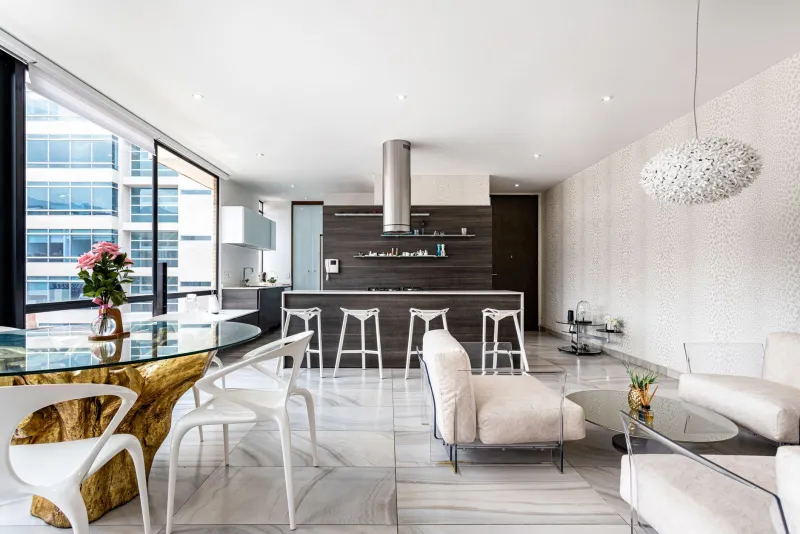
The practical vocabulary of modular luxury design is more architecturally sophisticated than the term "flexible space" might suggest. This is not a matter of installing a Murphy bed in a guest room and calling it done. The most compelling examples of adaptive luxury design involve structural decisions made at the planning stage — decisions that preserve optionality as a permanent feature of the residence.
Operable partition walls, when executed at a luxury specification, bear little resemblance to the accordion-fold dividers of conference rooms past. Contemporary high-end versions use floor-to-ceiling panels in lacquered wood, brushed metal, or fabric-wrapped acoustic composites that slide, pivot, or stack with the smooth precision of fine cabinetry. A single gesture can transform a 2,400-square-foot open-plan living area into a formal entertaining suite on one side and a private study on the other — or combine both into a single volume for a larger gathering.
Furniture systems designed for the adaptive home take the concept further. Custom millwork that conceals a fully equipped home office behind closed panels — desk, dual monitors, dedicated lighting, and cable management — allows a room to present as a serene sitting room until the moment professional demands require otherwise. Retractable projection screens and motorized acoustic panels can convert a living room into a screening environment in minutes. Wellness spaces — yoga studios, meditation rooms, treatment rooms — are being designed with the structural reinforcement and ceiling heights necessary to serve as guest suites or formal dining rooms when the occasion demands.
The Economics of Optionality
From a market perspective, the adaptive luxury residence represents a compelling value proposition that transcends the lifestyle arguments. Properties that can accommodate the full range of how affluent professionals live — working, entertaining, recovering, hosting, creating — appeal to a broader spectrum of buyers and, critically, remain relevant across longer ownership horizons.
A home designed around a fixed lifestyle model — say, the formal entertaining requirements of a pre-pandemic professional — may feel misaligned within a few years as circumstances evolve. A home designed around optionality, by contrast, ages well precisely because it does not commit its owner to any single mode of living. It grows with them, or pivots with them, or simply waits in elegant readiness for the next chapter.
Brokers who specialize in the upper tiers of the Manhattan market report that the language buyers use has shifted noticeably. "Potential" and "versatility" — terms that once carried a slightly apologetic connotation, implying that a space was not yet what it should be — are now invoked with genuine enthusiasm. A room with potential is no longer a room that needs work. It is a room that offers freedom.
Opulence Reconsidered
None of this suggests that the appetite for beauty, craftsmanship, and material richness has diminished among high-net-worth buyers. Quite the contrary. The adaptive luxury home is not a minimalist retreat from opulence; it is opulence redeployed. The finest stones, the most considered lighting, the most precisely engineered hardware — all of these remain non-negotiable at the top of the market. What has changed is the spatial logic that organizes them.
The grandest homes of the current era are not those with the most rooms. They are those with the most responsive ones — spaces that honor the full complexity of how their owners live, work, and inhabit the world. In a market where genuine distinction is increasingly difficult to achieve through scale alone, the home that bends may prove to be the most enduring luxury of all.