Sky, Reclaimed: The Modern Penthouse and Its Triumphant Return to the Apex of Urban Desire
There was a period, not long ago, when the penthouse seemed to have lost its grip on the luxury imagination. The ultra-high-net-worth buyer who might once have aspired to a full-floor aerie above the city was instead drawn earthward — to the brownstone on a quiet Brooklyn block, the ground-floor townhouse with its own private entrance and walled garden, the boutique building of twelve units where the elevator opened directly into the foyer. Intimacy, it seemed, had eclipsed altitude as the organizing aspiration of luxury urban living.
That moment has passed. The penthouse is back — and it has returned not as a nostalgic revival but as something genuinely evolved.
Why the Retreat Happened
To understand the current renaissance, it helps to understand what drove the earlier retreat. The penthouses of the 1990s and early 2000s were, in many respects, magnificent disappointments. Their glass curtain walls, so spectacular in photographs, admitted solar heat that overwhelmed early HVAC systems and created interiors that were scorching in July and drafty in January. Rooftop terraces were often unusable for significant portions of the year — too hot, too cold, too exposed to wind at elevations where the urban atmosphere behaves differently than it does at street level.
Noise was a subtler but equally corrosive problem. Mechanical equipment — the HVAC units, water towers, and elevator machinery that live on rooftops — created a constant low-frequency hum that penetrated even well-constructed slabs. And for buildings near flight paths, altitude amplified rather than insulated against aircraft noise.
Then there was the matter of the elevator. A single point of vertical access, shared with building staff and service deliveries, felt less private than a townhouse with its own street entrance. For buyers who had grown accustomed to the particular discretion of ground-level living, the penthouse offered exposure rather than sanctuary.
The Engineering Revolution That Changed Everything
The penthouses being delivered in 2024 and 2025 bear only a superficial resemblance to their predecessors. The transformation is not primarily aesthetic — though the design has evolved considerably — but mechanical and structural. A generation of engineering innovation has addressed, with remarkable precision, the specific failures that once made penthouse living an exercise in compromise.
Contemporary climate control systems for top-floor residences now routinely incorporate radiant floor and ceiling heating and cooling, supplemented by variable refrigerant flow HVAC technology that can maintain precise temperature zones throughout a large floor plate without the temperature differentials that plagued earlier generations of forced-air systems. Triple-glazed, argon-filled window assemblies with electrochromic tinting — glass that darkens automatically in response to solar intensity — have made the floor-to-ceiling glass wall a practical proposition rather than a thermal liability.
Acoustic engineering has undergone an equally significant evolution. Mass-damped mechanical rooms, floating slab construction, and bespoke acoustic ceiling assemblies have dramatically reduced the transmission of both mechanical and airborne noise into penthouse interiors. In some of the most technically advanced buildings — 432 Park Avenue in New York being a notable if controversial example — the upper floors are acoustically quieter than comparable units far below, a counterintuitive outcome made possible by the isolation of mechanical systems and the elimination of street-level noise sources.
The Outdoor Revolution
Perhaps no single factor has done more to rehabilitate the penthouse's reputation than the transformation of outdoor space design at elevation. The terrace of the classic penthouse was often a windswept afterthought — a concrete slab with a glass railing and a few potted plants, lovely in photographs and uninhabitable in practice for most of the calendar year.
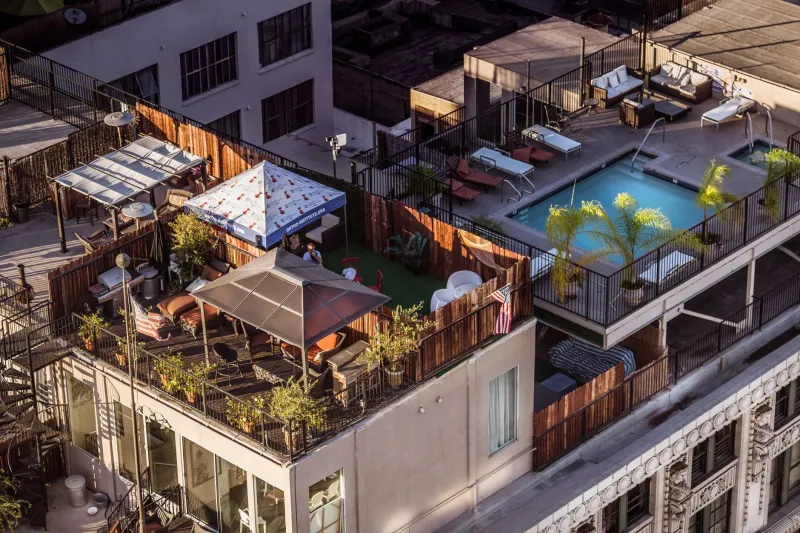
The outdoor environments now being created atop luxury towers in New York, Miami, Chicago, and Los Angeles are categorically different propositions. Landscape architects specializing in high-elevation environments — a genuinely specialized discipline that barely existed two decades ago — are designing spaces that account for wind patterns, solar angles, and microclimate conditions specific to each building's location and height. Automated louvered pergolas, retractable glass enclosures, and programmable misting and heating systems extend the usable season of outdoor spaces dramatically.
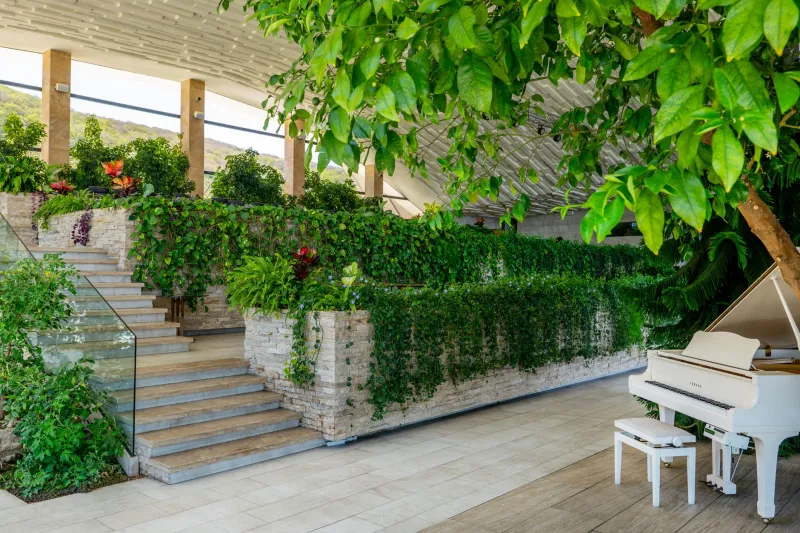
Planting schemes have become more sophisticated as well. Where earlier rooftop gardens relied on hardy, wind-tolerant species that conveyed a somewhat institutional aesthetic, contemporary installations incorporate mature specimen trees in engineered soil assemblies, perennial plantings with genuine seasonal interest, and irrigation systems calibrated to the specific water stress conditions of elevated urban environments. The result, in the most accomplished examples, is an outdoor space that feels less like an architectural accessory and more like a private park suspended above the city.
Privacy, Redesigned
The privacy concern that once drove buyers toward ground-level living has been addressed through a combination of architectural planning and building technology. Dedicated penthouse elevator banks — separate from the building's main vertical circulation — have become a standard offering in top-tier developments, eliminating the shared-lobby vulnerability that troubled security-conscious buyers.
Some buildings have gone further. At select ultra-luxury towers in Manhattan and along Miami's Brickell corridor, penthouse units are accessible only through a private lobby with independent street access, a concierge dedicated exclusively to top-floor residents, and a biometric access system that logs every entry and exit. The penthouse, once the most exposed address in a building, has in these cases become its most fortified.
The floor-plate itself has been reimagined to provide privacy at elevation. Strategic placement of solid parapet walls, mature planting screens, and architectural fins prevents sightlines from adjacent buildings while preserving the panoramic views that justify the altitude. The tension between visibility and privacy — long one of the penthouse's defining contradictions — has been resolved through design rather than conceded.
The Return of Verticality as Aspiration
There is something else at work in the penthouse's resurgence that transcends engineering: a cultural recalibration of what it means to occupy the highest point of an urban landscape. After a decade in which luxury was communicated through restraint and groundedness, there are signs that the pendulum is swinging back toward the declarative — toward spaces that make an unambiguous statement about the altitude, literally and figuratively, from which their occupants engage with the world.
The city viewed from above is a fundamentally different city than the one encountered at street level. It is ordered rather than chaotic, legible rather than overwhelming, beautiful rather than indifferent. For buyers who spend their professional lives navigating complexity and ambiguity, there is genuine psychological value in a home that offers clarity — that places the urban environment in perspective rather than immersing one within it.
The penthouse, at its best, has always offered that. What has changed is the technology's ability to deliver on the promise without the accompanying misery. The sky, it turns out, was always worth reclaiming. We simply needed the tools to do it properly.
At 112 Mercer, we believe that elevated living is more than a metaphor. The city's most extraordinary residences have always been found at its apex — and the apex has never been better equipped to receive them.