Preservation as Priority: The Rise of Intelligent Storage in the Luxury Home
For generations, storage was the afterthought of residential design — the utilitarian concession made after every grander ambition had been accommodated. Closets were deep and dark. Wine was kept wherever a wall permitted. Artwork leaned against baseboards awaiting a decision that never quite arrived. In the luxury market of 2024, that era has ended decisively.
Across the country's most coveted addresses — from SoHo lofts to Bel Air estates, from Chicago's Gold Coast to Miami's Brickell corridor — a quiet revolution is underway. The wealthiest homeowners are no longer treating storage as an amenity. They are treating it as infrastructure, and they are commissioning designers, engineers, and technologists to build preservation systems worthy of the collections they protect.
Beyond the Walk-In: The Climate-Controlled Wardrobe as Investment Vault
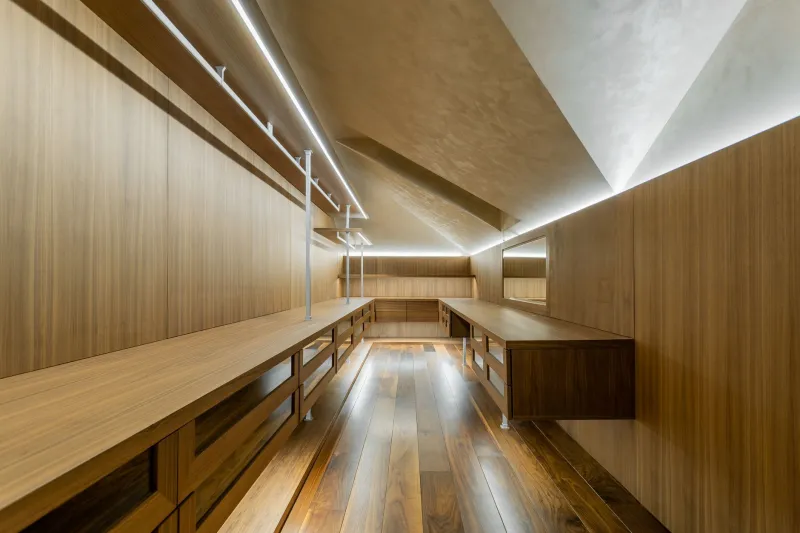
The modern luxury closet bears little resemblance to its predecessor. Where once a generous footprint and custom millwork sufficed, today's high-end wardrobe suites incorporate environmental monitoring systems capable of maintaining temperature within a single degree and humidity levels precise enough to satisfy a museum conservator.
The rationale is straightforward. A serious wardrobe — one that includes bespoke tailoring from Savile Row, heritage handbags, vintage footwear, and collector-grade accessories — may represent an asset portfolio worth several hundred thousand dollars or more. At that level of investment, the case for climate control becomes not merely aesthetic but financial.
Designers working at the apex of the residential market now routinely specify ultraviolet-filtering LED systems that protect dye-sensitive fabrics from degradation. Humidity sensors connected to central building management platforms alert homeowners — or their household managers — when conditions drift outside acceptable parameters. Some installations incorporate RFID tagging systems that allow every garment and accessory to be catalogued, insured, and located within seconds via a dedicated application.
"The closet has become the most technologically sophisticated room in the house," notes one New York-based interior architect who has completed wardrobe commissions exceeding two million dollars. "Clients are not simply organizing their clothes. They are curating and protecting a collection."
The Cellar Reimagined: Wine Storage as a Statement of Connoisseurship
If the wardrobe represents the personal dimension of luxury storage, the wine cellar embodies its social one. For decades, a well-appointed cellar was considered a mark of refinement in any significant residence. Today, the standards have risen considerably.
Contemporary wine cellars in the ultra-luxury segment are engineered environments. Vibration isolation technology — originally developed for laboratory and medical applications — is now deployed beneath racking systems to prevent the subtle agitation that can, over years, compromise a wine's development. Dual-zone cooling systems maintain separate conditions for red and white inventory. Argon gas injection systems are available for cellars housing opened bottles of exceptional value.
In residences where the wine collection is itself a financial instrument — and collections worth seven figures are not uncommon among the clientele that populates buildings at this market tier — the infrastructure investment is proportionate. A cellar built to professional-grade specification, with independent power backup and remote monitoring, may cost as much as a premium kitchen renovation. For owners whose inventory includes first-growth Bordeaux and verticals of California cult producers, this expenditure requires little justification.
The design dimension is equally considered. The finest cellars are conceived as destination spaces — rooms that invite extended visits and communicate the owner's relationship to wine as culture rather than mere consumption. Glass-enclosed tasting alcoves, bespoke racking fabricated from reclaimed French oak, and discreet display niches for trophy bottles have become standard features in residences at the highest price points.
Art Storage: The Hidden Gallery
Perhaps no storage category has evolved more dramatically than the provisions made for fine art. As the global art market has matured and collectors have grown more sophisticated, the gap between how art is displayed and how it is stored has narrowed significantly.
Leading residential designers now specify dedicated art storage rooms — sometimes called study storage or collection rooms — that replicate the archival conditions of professional art handling facilities. Climate control in these spaces operates independently of the home's primary HVAC system, ensuring that fluctuations caused by cooking, bathing, or seasonal temperature swings do not propagate into the collection environment.
Sliding panel systems allow large-format works to be stored flat or vertically with appropriate padding and separation. Digital inventories, linked to insurance records and provenance documentation, mean that a collector can access a complete catalogue of stored works from any device. Some installations integrate with fine art logistics platforms, enabling seamless coordination when works are loaned to institutions or transported between residences.
The convergence of storage and display is particularly notable in residences designed around significant collections. In these homes, the boundary between the gallery and the archive dissolves — works rotate between prominence and preservation according to the owner's preference, with each transition managed by systems designed to minimize handling and risk.
The Architecture of Discretion
What unites all of these developments is a shared aesthetic philosophy: the best storage is invisible. The technology that preserves a cashmere coat or a case of Screaming Eagle should be imperceptible to anyone not looking for it. The infrastructure that protects a Basquiat should disappear behind a surface indistinguishable from the surrounding wall.
This commitment to concealment demands a level of coordination between designers, contractors, and technology integrators that was once reserved for commercial projects. In the most ambitious residential commissions, the mechanical systems supporting storage environments are as carefully engineered as those supporting a building's structural frame.
The result, when executed with precision, is a home that appears effortlessly serene — all clean lines and considered proportion — while concealing, behind its surfaces, a sophisticated apparatus of preservation. The collection endures. The investment is protected. And the space, to every casual observer, remains simply beautiful.
In the luxury market, that combination of intelligence and restraint is, increasingly, the definition of good design.